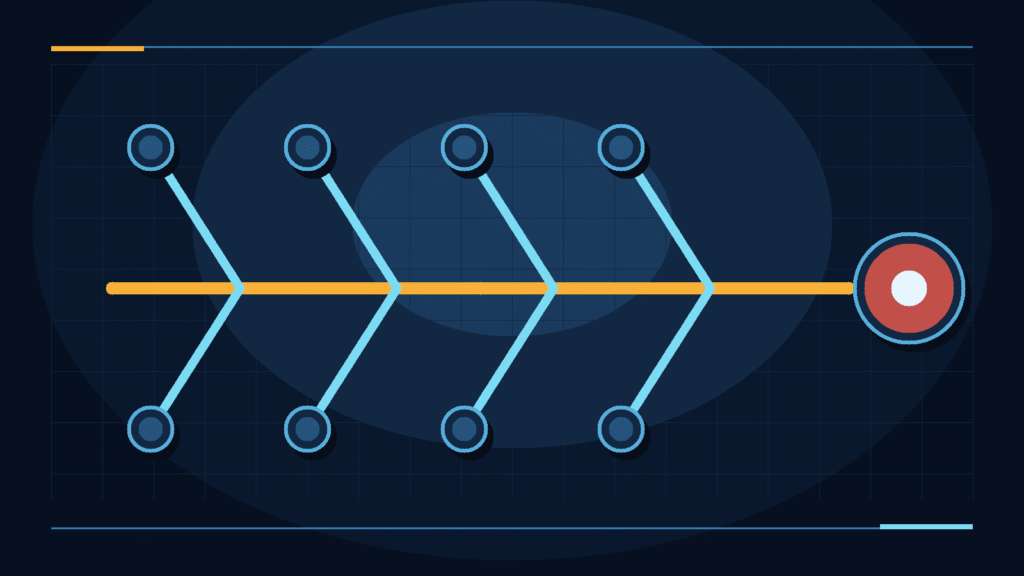
Root cause analysis examples demonstrate how to move beyond a visible symptom and investigate the conditions that allow a problem to occur or recur. A convenient explanation is not necessarily a supported cause, and a single causal chain may hide interactions between several factors. This guide explores six original hypothetical operational cases, showing how to investigate causes, compare evidence and verify corrective actions without assigning blame prematurely.
Quick Answer
Define the problem and its baseline, preserve relevant observations, map the sequence of events, identify plausible contributing conditions and test alternative explanations. Choose corrective actions that address supported mechanisms, assign owners and verify whether recurrence decreases without creating unacceptable side effects.
Table Of Contents
- What Is Root Cause Analysis?
- Separate Symptoms, Causes And Actions
- Worked Example: A 5 Whys Investigation
- Worked Example: Fishbone Analysis With An Evidence Register
- Worked Example: Change Analysis After Performance Deteriorates
- Worked Example: Barrier Analysis And Failed Controls
- Worked Example: Testing Competing Cause Hypotheses
- Worked Example: Verifying A Corrective Action
- Root Cause Analysis Worksheet And Review
- Frequently Asked Questions
What Is Root Cause Analysis?
Root cause analysis, or RCA, is a family of investigative approaches for understanding underlying causes of undesirable outcomes. It distinguishes the observed result from the conditions that contributed to it. The aim is not simply to find a person or event associated with the failure, but to discover changeable conditions that can reduce recurrence. Some problems have several interacting causes, and a useful investigation may produce more than one corrective action.
The American Society for Quality root cause analysis guidance describes approaches including change analysis and barrier analysis. The AHRQ root cause analysis resource illustrates investigation of underlying factors in a quality-improvement setting. These references inform the general investigative principles here; the fictional cases do not represent clinical incidents or specialized compliance assessments.
Our problem definition examples explain how to establish the initial gap. RCA begins after a problem has been described clearly enough to investigate. In urgent circumstances, first contain the immediate problem and obtain any necessary specialist support. Investigation and immediate containment are related but serve different purposes.
Separate Symptoms, Causes And Actions
| Concept | Illustrative Statement |
|---|---|
| Symptom | Twelve requests missed the delivery target |
| Direct Cause Hypothesis | Required details were absent at review |
| Contributing Condition | Submission instructions did not identify those details |
| System Condition | No owner reviewed the instructions after requirements changed |
| Containment | Contact affected requesters and correct the records |
| Corrective Action | Revise and test the instructions and assign update ownership |
Each line after the observed symptom must be supported by evidence before being treated as established. The instructions may be unclear, or users may have been unable to provide the information regardless of their clarity. A revised form will not address a lack of available information. A causal explanation is useful when it identifies a mechanism that can be examined and, where feasible, changed.
Avoid defining a root cause as the last answer obtained after asking why five times. The number of questions is a prompt, not a stopping rule. Stop when the relevant causal conditions are adequately supported and actionable for the investigation’s scope, or record the unresolved uncertainty. Further questions may reveal important external influences or lead beyond the authority of the investigator.
Worked Example: A 5 Whys Investigation
A fictional community service reviews late requests. Of 40 requests, ten exceed the agreed response time. The team discovers that several late cases wait for clarification. Instead of assuming that contributors work too slowly, it investigates one representative sequence using records and conversations.
| Question | Proposed Answer | Evidence To Verify |
|---|---|---|
| Why was the request late? | Review waited for an essential detail | Case timestamps |
| Why was the detail absent? | The intake form allowed omission | Saved form and submission |
| Why did the form allow omission? | The field was introduced in a later requirement | Requirement history |
| Why was the form not updated? | Changes were communicated only to reviewers | Notification record |
| Why was intake not notified? | No cross-role requirement update process | Ownership and procedure review |
This chain is an example of a possible explanation, not a conclusion about all ten late requests. Test additional late cases and compare timely cases. If the form omission appears frequently in timely requests as well, another factor may determine whether clarification creates a delay. If different request types have different requirements, investigate them separately.
A suitable corrective action could include updating the intake form, making exception handling available and assigning responsibility for future requirement changes. A reminder to review faster would not address the proposed communication gap. Measure clarification frequency and timely delivery using the same eligibility rules. Our process mapping guide can help locate the relevant handoffs.
Worked Example: Fishbone Analysis With An Evidence Register
A fictional reference group experiences inconsistent item retrieval. A fishbone diagram can organize candidate causes into categories such as people, information, methods, resources and environment. Categories are prompts for exploration rather than assertions that every category contributes to the problem. The investigator should include causes that challenge the group’s initial preferred explanation.
| Category | Candidate Cause | Evidence Question |
|---|---|---|
| Information | Inventory identifiers do not match labels | How often do sampled identifiers differ? |
| Methods | Returns are recorded inconsistently | Which return steps are observed? |
| Resources | Reference cards are unavailable | Are required cards present at the point of use? |
| People And Support | New volunteers lack orientation | Do errors differ by experience or assistance? |
| Environment | Similar items are difficult to distinguish | Which items produce retrieval errors? |
Suppose a sample of 30 unsuccessful retrieval attempts includes 18 with label mismatches, eight with missing reference cards and six involving a new volunteer. The categories may overlap, so their counts cannot be added to produce 32 distinct failures. Preserve case-level information or clearly identify the classification rule. A large count also does not establish that the factor caused every associated failure.
The team compares unsuccessful and successful retrievals using the same definitions and observes how labels are actually used. If mismatches frequently appear in unsuccessful cases but rarely in comparable successful cases, the label mechanism deserves a focused test. Use a small pilot with consistent labels while retaining other relevant conditions where feasible. Document whether independent retrieval improves and whether maintenance becomes more burdensome.
Worked Example: Change Analysis After Performance Deteriorates
A group reports that activity notices became less reliable after a process revision. In the previous period, four of 80 notices contained a detected discrepancy. In the next period, 12 of 80 contained one. The observed rates are five and 15 percent respectively. The timing suggests investigating what changed, but a sequence in time does not establish causation.
| Possible Change | Evidence To Compare |
|---|---|
| New schedule approval sequence | Approval and publication timestamps |
| Different notice template | Required fields and version history |
| New coordination arrangements | Roles and actual handoffs |
| More complex activity types | Comparable notice categories |
| Different review practice | Consistency of error detection |
Change analysis compares conditions before and after the deterioration to identify candidate explanations. The discrepancy rate rose by ten percentage points and is three times its previous value. Those numerical facts do not indicate which change produced the increase. The review should check whether the later detection process was more thorough, because improved detection alone can increase reported errors.
If the evidence shows that notices are sometimes sent before schedule approval, examine why the sequence changed and whether an approval indicator is available. Test a verified release condition rather than broadly reversing every recent improvement. Compare error rates, waiting and legitimate urgent exceptions. The multidimensional case analysis guide discusses alternative explanations in before-and-after comparisons.
Worked Example: Barrier Analysis And Failed Controls
A shared resource service discovers that an item was reserved twice. The agreed procedure includes an availability check and a confirmation record. Barrier analysis examines the controls that should prevent or detect the error and asks whether they were absent, unsuitable or ineffective in operation. The ASQ discussion of root cause analysis explains the role of barriers and change analysis.
| Expected Barrier | Observed Condition | Next Investigation |
|---|---|---|
| Check availability before confirming | Two separate calendars were consulted | Which record is authoritative? |
| Record confirmed reservation | One confirmation remained in a message | Can the owner update the record at confirmation? |
| Review changes and cancellations | Updates were handled informally | Is there a defined update responsibility? |
Do not assume every missing check requires adding another check. A stronger response might remove the conflicting records or change the confirmation sequence so the authoritative record is updated before the confirmation is sent. Assess access requirements and exceptions before choosing a new arrangement.
The team tests representative booking, cancellation and amendment cases. A successful test should show both that conflicting reservations are detected and that legitimate requests can still be handled. Review the control after a period of ordinary operation. Our risk assessment examples explain how to distinguish planned controls from verified operating controls.
Worked Example: Testing Competing Cause Hypotheses
A team wants to explain why reference requests take longer on some days. One hypothesis is that incoming volume exceeds available review capacity. Another is that a larger proportion of complex requests requires additional checking. A third is that reviewers receive information late. Each explanation can produce a similar symptom, so the investigation must identify evidence that distinguishes them.
| Hypothesis | Prediction If It Contributes | Potential Test |
|---|---|---|
| Volume exceeds capacity | Queue grows on comparable high-volume days | Compare arrivals, completions and staffing |
| Complexity increases | Similar volumes produce longer review effort | Compare defined request categories |
| Information arrives late | Requests wait before substantive review | Compare information-ready and review-start timestamps |
Select observations that can challenge each explanation, not just confirm the preferred one. For instance, a long queue during a low-volume day might weaken a volume-only explanation but could reflect an accumulated backlog. Record opening workload and outstanding cases rather than interpreting daily arrival counts in isolation.
If several explanations remain plausible, a focused pilot may distinguish them. Test improved information availability for one comparable request category while keeping the review capacity stable where feasible. Measure whether waiting before review changes. Do not describe a pilot as a controlled causal experiment when the conditions do not support that claim. Use the systems thinking framework to investigate feedback and interacting constraints.
Worked Example: Verifying A Corrective Action
A fictional group changes the intake instructions after investigating incomplete submissions. In a baseline sample, 18 of 60 records are incomplete. The first pilot contains six incomplete records out of 40. The later follow-up contains nine incomplete records out of 60.
| Period | Incomplete Records | Eligible Records | Observed Rate |
|---|---|---|---|
| Baseline | 18 | 60 | 30% |
| Pilot | 6 | 40 | 15% |
| Follow-Up | 9 | 60 | 15% |
The observed rate is 15 percentage points lower than baseline in both later samples, a relative reduction of 50 percent. That is consistent with a sustained improvement over the observed periods. The comparison still needs stable definitions, comparable case composition and evidence that the revised instructions were available and used. Check whether the process discouraged unusual but legitimate submissions.
If adoption is low, investigate why the proposed action was not implemented. If adoption is high but the outcome remains poor, revisit the causal explanation. A corrective action should not be closed solely because instructions were published. The action plan guide helps connect actions to acceptance evidence and follow-up.
Root Cause Analysis Worksheet And Review
| Field | Record |
|---|---|
| Problem | Observed gap, boundary and baseline |
| Containment | Immediate action and remaining exposure |
| Evidence | Records, observations and missing information |
| Timeline | Sequence and relevant changes |
| Cause Hypotheses | Plausible contributing conditions |
| Tests | Evidence for and against each explanation |
| Controls | Expected barriers and operating evidence |
| Corrective Action | Supported mechanism, owner and acceptance criteria |
| Outcome | Recurrence measure and balancing measures |
| Review | Date, limitations and next action |
A useful review distinguishes confirmed events from suspected conditions and does not confuse the presence of an error with the reason it occurred. Ask whether the investigation examined alternative explanations, relevant exceptions and controls. Keep the scope proportionate to the consequences and obtain suitable specialist expertise when the matter demands it.
The central question is whether the corrective action changes a supported mechanism and whether that change is associated with the desired result under relevant conditions. Review recurrence over a suitable period, track unwanted effects and update the investigation when evidence challenges the explanation. The purpose of RCA is better prevention and learning, not an impressive diagram or a predetermined attribution of blame.
Frequently Asked Questions
What is root cause analysis?
A family of investigative approaches that examine underlying conditions contributing to an undesirable outcome.
What is the difference between a symptom and a cause?
A symptom is the observed effect; a cause is a condition or mechanism that contributes to it.
What are the 5 Whys?
Repeated questioning used to explore a plausible causal chain, with evidence checks at each step.
Must an investigator ask exactly five questions?
The number is a prompt; the evidence and scope determine when to stop.
What is a fishbone diagram?
A way to organize possible contributing causes into useful categories for investigation.
What is change analysis?
Comparison of relevant conditions before and after a change in performance.
What is barrier analysis?
Investigation of controls intended to prevent or detect a problem and why they were ineffective.
Can there be multiple root causes?
Several interacting contributing conditions may require different corrective actions.
How do you validate a cause?
Examine the mechanism, supporting and contrary observations, alternative explanations and suitable tests.
How do you verify corrective action?
Confirm implementation and compare recurrence and balancing measures with the baseline.