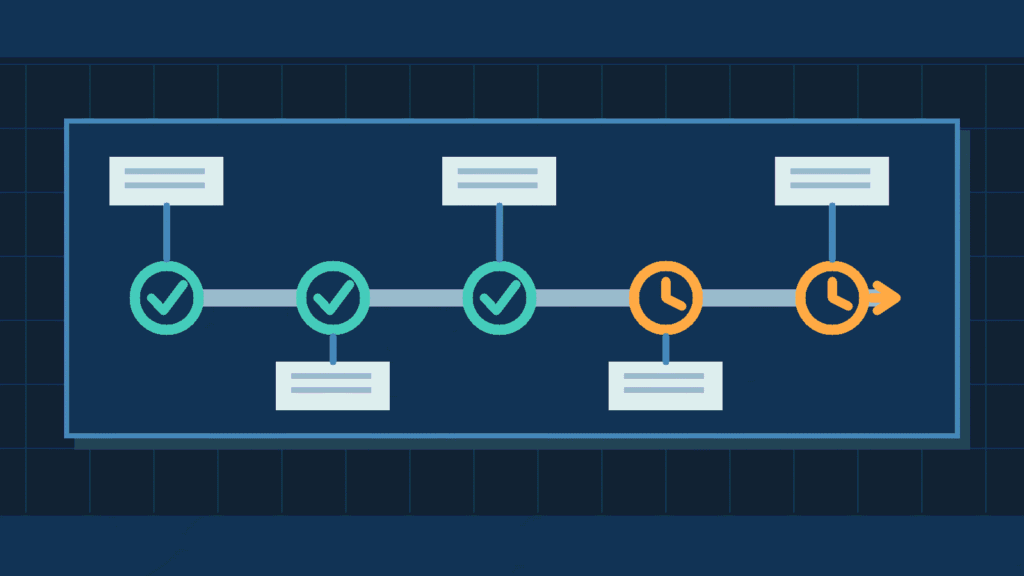
An action plan can contain a long list of dated tasks and still leave the team unsure whether the project is progressing. A useful milestone is more than a line in a calendar. It identifies a significant state that must be reached, the evidence that demonstrates it, who owns the result and when the next decision can safely be made.
This guide applies the SMART framework to implementation milestones rather than simply listing examples of goals. A fictional community center will introduce a new reservation and request-handling process. We will turn vague checkpoints into measurable acceptance gates, calculate schedule implications, handle partial completion and create a reusable milestone register. The examples are hypothetical and are intended for general project planning.
Quick Answer
A SMART action milestone specifies a meaningful implementation result, measurable acceptance criteria, an achievable path, relevance to the project outcome and a deadline. A strong example is: by the end of working day 15, the process lead will obtain documented approval of pilot readiness after a test that completes at least 18 of 20 representative test cases correctly, with all mandatory access and privacy checks passed. The milestone is achieved only when the required evidence is accepted, not when the deadline arrives or the team reports that most tasks are finished.
Distinguish Milestones From Tasks And Outcomes
A task consumes time and resources. A deliverable is an output produced through work. A milestone marks a significant event or accepted state in the plan. An outcome is a change that the project is intended to create. These distinctions matter because a team can complete all its planned activities and still fail to produce an acceptable result.
For example, drafting a new booking form is a task. The finished form is a deliverable. Obtaining approval that the form satisfies the agreed requirements is a milestone. Reducing avoidable reservation errors is an outcome. A milestone may be defined around achievement of an outcome when that outcome can be verified by a certain date, but it should not automatically be treated as proof of long-term impact.
SMART is commonly expressed as specific, measurable, achievable, relevant and time-bound. Applying it to a milestone means defining the state to be achieved and the evidence required to accept that state. The milestone itself is normally represented as a zero-duration event in a schedule; the activities and reviews necessary to reach it consume time. For general action planning, the CDC SMART framework offers an accessible starting point. In a project, the team must also decide who has authority to accept a milestone and what happens if the evidence falls short.
Avoid using every minor task completion as a milestone. If the register contains forty trivial checkpoints, it becomes difficult to see which ones govern decisions. Select events that change project readiness, unlock dependent work, confirm an important deliverable or trigger a review of scope and resources. The action plan examples guide covers the broader process of turning solutions into owned activities.
| Item | Example | How to verify |
|---|---|---|
| Task | Draft booking procedure | Work completed |
| Deliverable | Versioned procedure | Output exists |
| Milestone | Procedure approved | Acceptance recorded |
| Outcome | Fewer booking errors | Measured performance |
Translate Vague Milestones Into Verifiable Statements
Consider the proposed milestone “Booking process ready by the end of the month.” It has a general date but leaves the meaning of ready undefined. One team member may think it means that the draft form exists, while another expects tested instructions, a working fallback and approval from the service owner. The ambiguity becomes visible only when the deadline approaches.
A better version states that by working day ten, the process lead will submit a version-controlled booking workflow and user instructions, with every mandatory requirement from the agreed checklist traced to a document section or demonstrated procedure, and the service owner will record acceptance. This milestone specifies the output, acceptance evidence, accountable person and date.
The word achievable requires a practical check rather than a positive attitude. If the team has only one reviewer and the reviewer is unavailable on working days nine and ten, the proposed date may be unrealistic. Arrange a review earlier, identify an authorized alternate or change the approved date. Do not call a milestone achievable merely because someone inserted it into a schedule.
Relevance also requires more than a connection to a general project goal. The booking workflow matters because the next pilot must use consistent instructions. A milestone for designing an attractive presentation may be irrelevant if it does not unlock the pilot or contribute to the intended outcome. Ask what decision changes when the milestone is achieved.
A time-bound statement should specify a date or a well-defined relative deadline and the applicable calendar. “Within ten days” can mean calendar days or working days. “By working day ten, 17:00 local time” is less ambiguous. For an internal project with multiple time zones, define the controlling time zone and avoid conflicting interpretations of the deadline.
Create A Milestone Register For The Implementation Example
The fictional center has a six-week implementation window. The team wants to reduce avoidable booking errors while preserving equitable access and clear communication. It will document the current process, approve the revised requirements, prepare the new procedure, run a small pilot, decide whether the procedure is ready to expand and review actual performance.
The first milestone is a baseline accepted by working day five. The coordinator must reconcile one hundred representative historical booking records, describe the categories of observed errors and document any missing data. The service owner accepts the baseline only after confirming that its denominator and definitions are consistent. This provides a defensible comparison point for subsequent measures.
The second milestone is requirements approval by working day eight. The project lead presents the agreed list of mandatory and desirable requirements, including a fallback procedure and the method for handling exceptions. The approval is recorded before the team treats the requirements as fixed for the pilot. Changes remain possible, but they must be documented through the agreed change process.
The third milestone is readiness for the pilot by working day fifteen. The process lead must provide the approved instructions, evidence that representative cases can be handled, confirmation that required checks work and a suitable rollback plan. The operational owner is responsible for accepting the milestone. A draft document or an informal statement that the team feels ready does not satisfy the gate.
The fourth milestone is pilot evaluation by working day twenty-two. The team must report completed cases, errors, exceptions, staff handling time and participant feedback using the same definitions wherever practical. The decision maker records whether to expand, revise or stop the procedure. This milestone marks a decision, not necessarily successful expansion.
The final milestone is the operational review by working day thirty. If the change has been accepted for limited expansion, the team compares the new performance measures with the baseline and checks for unintended effects. If the pilot was stopped or revised, the milestone is the documented review of that decision and the evidence supporting the next action. The project is not automatically a success simply because thirty working days have elapsed.
| Milestone | Target working day | Acceptance evidence |
|---|---|---|
| Baseline accepted | 5 | Reconciled sample and definitions |
| Requirements approved | 8 | Agreed requirements register |
| Pilot readiness accepted | 15 | Test results and required approvals |
| Pilot evaluated | 22 | Results and decision |
| Operational review | 30 | Performance review and next action |
Set Acceptance Criteria And Mandatory Gates
Suppose the readiness pilot contains twenty representative test cases. The team sets a threshold of at least eighteen correctly completed cases, equal to 90%. It also requires that all mandatory access, privacy and exception-handling checks pass. The numerical target is an illustrative project-specific choice, not a general standard.
Now consider a test result in which nineteen of twenty cases are handled correctly, but one mandatory access check fails. The overall score is 95%. Despite exceeding the numerical threshold, the readiness milestone remains unmet because the mandatory condition was not satisfied. A high aggregate score must not compensate for an essential control failure.
A second result has eighteen correctly completed cases and all mandatory checks passed. This meets the example test threshold and mandatory conditions, provided the evidence is complete, the rollback procedure is accepted and the authorized person signs off. A third result has seventeen correctly completed cases, or 85%, with all mandatory checks passed. It fails the numerical threshold. The corrective action differs between these examples: one requires investigation of a mandatory control, the other requires addressing ordinary case-handling errors.
Acceptance criteria should identify the population, sample or test coverage, the calculation, the threshold and any mandatory conditions. For a real project, choose representative cases that include ordinary requests, unusual but foreseeable exceptions and relevant accessibility needs. Twenty convenient cases may not provide sufficient evidence for a consequential rollout. The scope of the test must fit the risks and complexity of the procedure.
Record the evidence location and its version. A reviewer should be able to find the exact test results that were accepted. If the form or procedure changes after acceptance, assess whether the earlier evidence still applies. A milestone does not permanently certify every future version of a deliverable. The Praxis Framework milestone planning guidance discusses linking project controls to predefined acceptance criteria.
| Case result | Correct cases | Mandatory checks | Gate status |
|---|---|---|---|
| A | 19/20 (95%) | One failed | Not met |
| B | 18/20 (90%) | All passed | Eligible for acceptance if other criteria met |
| C | 17/20 (85%) | All passed | Not met |
Calculate Dependencies And Schedule Feasibility
Milestone dates should follow from the work and dependencies needed to achieve them. Consider the readiness gate planned for working day fifteen. Assume the baseline is accepted at the end of day five. Requirements work takes three subsequent working days, ending on day eight. Drafting the revised procedure takes three working days, ending on day eleven. Representative testing takes two days, ending on day thirteen. The acceptance review takes one day, ending on day fourteen. Under these assumptions the earliest readiness acceptance is the end of day fourteen, leaving one working day before the target.
The path from baseline acceptance through requirements, drafting, testing and review consumes nine additional working days. Some work could proceed in parallel, but only when dependencies allow it. For example, preparing a test-case template may start before the requirements are formally accepted, while executing final acceptance tests should use the approved version of the relevant procedure.
Suppose drafting actually takes five days instead of three. If all later activities remain sequential and their durations do not change, the earliest readiness acceptance shifts from day fourteen to day sixteen. The one-day margin is exhausted, and the planned day-fifteen milestone is missed by one working day. The correct response is to reforecast honestly, identify feasible recovery options and obtain approval for any necessary change.
Do not recover schedule time by eliminating required verification. The team might arrange an additional qualified reviewer, complete independent preparation activities in parallel or narrow the pilot scope through a formally approved change. But it should not report acceptance before the required evidence exists.
A milestone has no independent duration in a conventional milestone schedule, but review and sign-off tasks do have durations. A plan that includes a milestone dated on day fifteen while omitting time for the reviewer to examine the evidence may be unrealistic. Add explicit review activities and account for resource availability. The resource allocation guide supports this feasibility check, while the milestone planning guide explains checkpoint dependencies and the planning and implementation guide explains how significant decisions connect across stages.
| Activity | Duration | Earliest completion day |
|---|---|---|
| Baseline acceptance | Existing milestone | 5 |
| Requirements | 3 working days | 8 |
| Drafting | 3 working days | 11 |
| Testing | 2 working days | 13 |
| Acceptance review | 1 working day | 14 |
| Target | 1 day margin | 15 |
Track Progress Without Treating Partial Work As Acceptance
Imagine the procedure has four component tasks: drafting, review, testing and correction. Drafting and review are complete, testing is 75% complete, and correction has not begun. If all four tasks are treated as equally weighted for a simple illustrative progress measure, task progress is (100 + 100 + 75 + 0) divided by four, or 68.75%. This is not the same as 68.75% of the readiness milestone being accepted.
A more useful register tracks the milestone as not started, in progress, at risk, blocked, awaiting acceptance, accepted or superseded. Define those labels consistently. Awaiting acceptance means that the required evidence has been submitted but the authorized decision has not been recorded. Accepted means that the defined criteria were met or that an explicitly authorized change to the criteria was approved and documented.
If the project contains five milestones and three have been accepted, the count-based milestone completion rate is 3 divided by 5, or 60%. This does not necessarily mean that 60% of the work, effort, budget or benefit has been delivered. Milestones vary in importance and complexity. Report schedule status and outcome measures separately.
Maintain both the baseline date and the current forecast date. A milestone originally due on day fifteen but forecast for day sixteen is at risk of missing the baseline. Moving the displayed deadline to day sixteen without preserving the original target conceals the schedule change. If the authorized owner approves a revised baseline, retain a change record explaining why.
A well-designed dashboard should show what evidence is missing, what dependency is blocked, who owns the recovery action and when the next review will occur. The purpose is to support decisions, not to reward a visually green status report. A team that accurately reports a delayed acceptance gate provides more useful information than one that declares it complete to satisfy a reporting deadline.
| Status | Meaning |
|---|---|
| In progress | Work or evidence preparation underway |
| At risk | Forecast may miss baseline |
| Blocked | Dependency or resource prevents progress |
| Awaiting acceptance | Evidence submitted, decision pending |
| Accepted | Acceptance decision recorded |
Apply SMART Milestones In Other Practical Settings
For an office inventory review, a weak milestone is “inventory cleaned up next week.” A more useful milestone is that by Friday at 16:00, the inventory lead has reconciled all fifty items in the defined storage area against the current register, recorded unresolved discrepancies and obtained the responsible owner’s approval of the reconciliation report. This does not require pretending that every discrepancy has been resolved; the milestone is the accepted reconciliation state.
For a community event, a weak milestone is “volunteers ready.” A stronger version states that by seven calendar days before the event, the coordinator has confirmed a suitable volunteer for every required role and identified an agreed fallback for each critical assignment, with the event owner approving the roster. The total number of volunteers is less important than the match between roles, time windows and agreed availability.
For a small documentation project, the milestone “handbook complete” could become: by the agreed review date, the documentation owner has submitted the version-controlled handbook, every mandatory section has passed the completeness checklist, and the designated reviewer has approved it for the intended audience. This avoids counting a draft as a release-ready output.
Each example identifies the state and evidence needed for acceptance. The exact dates, thresholds and reviewers should be tailored to the actual project. Do not copy a number from an example merely because it looks professional. The required precision depends on the consequences of a missed milestone and the ability of the team to verify it.
When milestone statements become too long, store the short event name in the schedule and keep the detailed acceptance specification in a linked register. A concise title such as “Pilot readiness accepted” is sufficient in the timeline when the associated criteria, owner and evidence are easy to locate.
Reusable SMART Milestone Register And Review Process
Create a register with a unique milestone identifier, short event name, target date, current forecast, accountable owner, acceptance authority, predecessor requirements, evidence location, mandatory criteria, status and decision date. If a milestone changes, record the approved reason and its implications for dependent work.
At each review, compare the forecast with the baseline and identify the evidence that remains missing. Ask whether the acceptance criteria are still appropriate, whether the resource plan is realistic and whether any dependency has changed. Do not quietly relax a criterion in order to meet a deadline. If the project purpose or scope genuinely changes, document the authorized revision and reassess affected milestones.
Use milestone reviews to decide whether to proceed, correct, defer or stop. Sometimes the correct outcome of a milestone review is a decision not to launch. That is not necessarily a planning failure. It can be evidence that the control structure worked and prevented an unsuitable implementation.
The most useful SMART milestones create a shared definition of readiness. They give the team a precise target while preserving the flexibility to investigate setbacks, revise plans and protect important requirements. A completed date without accepted evidence is merely a date. An accepted milestone should tell the team what has changed, why it matters and which decision can now be made.
| Field | Illustrative entry |
|---|---|
| Milestone | Pilot readiness accepted |
| Baseline / forecast | Day 15 / day 14 |
| Accountable owner | Process lead |
| Acceptance authority | Operational owner |
| Mandatory evidence | Test record, controls, rollback plan |
| Decision | Proceed, revise, defer or stop |
Frequently Asked Questions
What Is A SMART Action Milestone?
A meaningful implementation event defined by a specific state, measurable acceptance criteria, achievable plan, relevance and deadline.
Is A Milestone The Same As A Task?
A task consumes effort or time; a milestone marks a significant event or accepted state.
Should A Milestone Have A Duration?
In a conventional project schedule the milestone itself is zero-duration, while the work and reviews needed to reach it have durations.
How Do I Make A Milestone Measurable?
Specify the evidence, population or test coverage, calculation, threshold and any mandatory acceptance conditions.
Can A Milestone Be Partially Complete?
Work toward the milestone can be partially complete, but acceptance remains pending until the defined conditions are met.
What Happens If A Mandatory Criterion Fails?
The milestone remains unmet unless an appropriate authorized change is approved; an aggregate score cannot override the mandatory gate.
Who Should Accept A Milestone?
Assign the authority to the person or group responsible for deciding whether the deliverable or state is ready.
How Should A Delayed Milestone Be Reported?
Preserve the baseline, update the forecast and record the cause, recovery action and effect on dependencies.
How Many Milestones Should An Action Plan Have?
Use enough to mark significant decisions and readiness changes without making every minor activity a milestone.
Can A Milestone Review Decide To Stop A Project?
A review may appropriately result in a decision to revise, defer or stop when evidence does not support proceeding.