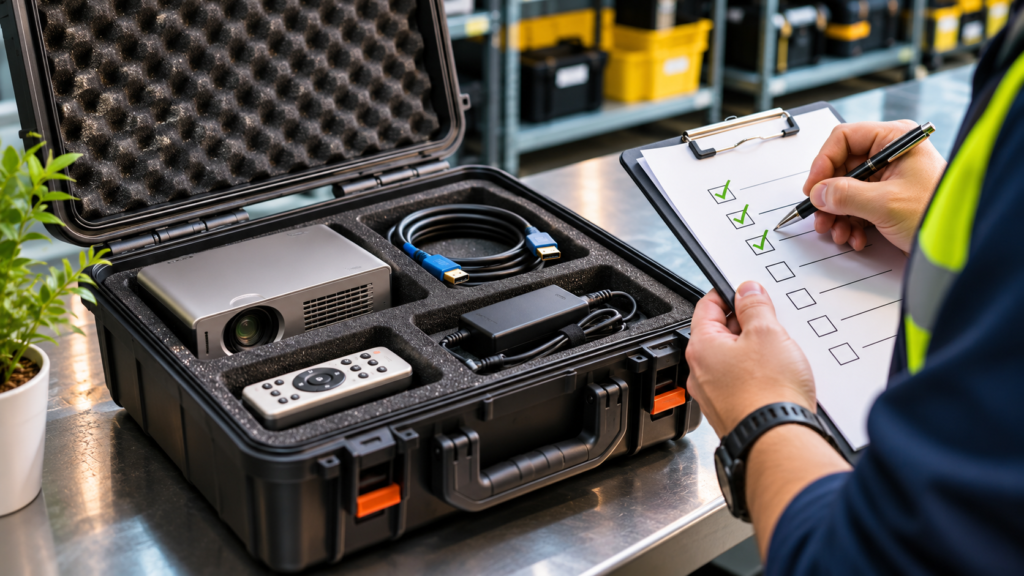
An equipment lending service can record a kit as returned even though its battery, cable or another required component is missing. If the kit is immediately marked available, the next borrower inherits a problem that was created during the previous handoff. Standard work and error proofing help prevent this recurring failure by defining a repeatable return sequence and making exceptions visible before an item is released.
This worked example considers a fictional community equipment library with twenty-four portable workshop kits. It explains how to design an inspection sequence, reconcile inventory states, calculate inspection capacity, distinguish detection from prevention and test a change without sacrificing necessary safety or quality checks. All numbers are illustrative. Equipment-specific inspection, repair and safety requirements must be established by appropriately qualified people for the actual equipment.
Quick Answer
An effective equipment return check separates physical receipt from readiness for the next loan. Identify the kit, compare its contents with an approved inventory, assess condition using the applicable inspection procedure, record exceptions, and release it only after all required checks pass. Error proofing can include clearly shaped component locations, version-controlled checklists and a status system that prevents an unverified kit from appearing available. Measure the number of complete, suitable kits released on time rather than the number of returns processed alone.
Define The Return Process And The Release Condition
Assume the library lends kits containing a case, a portable device, a charger, a cable and a set of accessories appropriate to the workshop. Some kits contain different components because they support different activities. A universal five-item list may therefore be unsuitable. Each kit needs an approved configuration associated with its identity or type.
The return process begins when a kit arrives at the service desk. The receiving worker confirms its identity and records the return. A designated worker then checks the required components and condition, carries out any authorized preparation and records the outcome. A suitable kit becomes ready for the next loan only after the defined checks pass. A kit with a missing or unsuitable component remains unavailable until the exception is resolved.
This distinction matters for both accountability and capacity. The borrower may have fulfilled the agreed obligation to physically return the kit, while the library has not yet completed its own inspection process. A pending inspection should not automatically be interpreted as a late return by the borrower. Similarly, discovering a damaged component does not automatically establish who caused the damage.
Define readiness as an identifiable kit with the approved required components, acceptable condition under the relevant procedure and a current availability status. A ready kit may still be committed to another borrower and therefore not freely available. The equipment borrowing feedback example explains the difference between physical inventory and reliable availability.
For equipment with specific hazards, use the applicable manufacturer instructions and qualified inspection or servicing requirements. The return checklist is an administrative control; it cannot replace technical verification or authorize an unqualified person to carry out a specialist repair.
Observe The Current Return Routine
The fictional library’s initial procedure is informal. One worker records a return at the front desk, another checks the contents whenever time is available, and a third prepares the kit for collection. On busy days, completed inspection is communicated verbally. The reservation system sometimes treats the recorded return as evidence of readiness.
Observe the actual work before changing the procedure. Record the moment of receipt, identity confirmation, inventory inspection, condition assessment, exception handling and release. Note where each task takes place, which information is needed, how people learn that an exception exists and whether the information is available to the next person.
In one illustrative sample of thirty returned kits, twenty-one are complete and suitable at the first check, six have missing components, and three require further condition assessment. These classifications are mutually exclusive for the example: where both types of exception are present, use the agreed priority rule or record multiple exception flags separately. The first-pass readiness rate is twenty-one divided by thirty, or 70%.
Suppose four of the six missing-component cases are resolved during the same shift, while two remain unresolved. One of the three condition-assessment cases is cleared by the appropriate person, while two remain unavailable. The shift releases twenty-six of the thirty returned kits, or approximately 86.7%. The remaining four must remain visible as exceptions rather than being hidden in a total of processed returns.
The sample tells the team that some returned units require additional work, but it does not prove that the original checkout process caused the exceptions. Review the checkout records, kit configuration and return evidence before attributing a missing component to a particular borrower or worker. A measured defect should lead to investigation, not automatic blame.
| Initial Classification | Kits | Share |
|---|---|---|
| Ready at first check | 21 | 70% |
| Missing components | 6 | 20% |
| Further assessment | 3 | 10% |
| Total | 30 | 100% |
Design A Repeatable Inspection Sequence
Standard work begins with a sequence that the people performing the work can understand and improve. The Lean Enterprise Institute reference on standardized work describes the conventional elements of work sequence, timing and standard in-process inventory. The equipment library adapts those concepts to a service setting with returned kits and inspection capacity.
The first step is identity confirmation. Match the physical kit identifier to the active loan or return record. If the identifier cannot be read or the record appears inconsistent, stop the ordinary workflow and investigate the discrepancy. Do not create a second inventory item simply to complete a transaction.
The next step is to select the correct configuration list. A shared checklist may identify common items, while the version-specific list identifies the accessories required for that particular kit. The worker checks presence, suitability and obvious exceptions under the authorized procedure. A count alone cannot establish that a cable or accessory is the correct one.
The subsequent condition check follows the applicable requirements for the equipment. Where a further inspection is necessary, route the item to the appropriate person instead of marking it ready based on an administrative receipt. Record the type of exception and the next action.
Finally, prepare and release the kit when all required checks have passed. Record the release time, the responsible worker or system and the resulting status. The ready state should represent a verified result, not an assumption that someone else completed the check. A later reservation may change the commitment status without altering the recorded inspection outcome.
A useful standard identifies the starting condition, expected result, responsible role and exception response for every step. This allows a worker to see not only what comes next but what to do when the normal condition is missing. See the standardized work examples guide for the broader methodology.
| Step | Expected Result | Exception Response |
|---|---|---|
| Identify | Correct kit and loan matched | Investigate unmatched identity |
| Check contents | Correct configuration verified | Record missing or wrong components |
| Check condition | Authorized checks passed | Refer for further assessment |
| Prepare and release | Ready status recorded | Keep unavailable if conditions fail |
Match Error Proofing Controls To Individual Failure Modes
Begin with the most consequential and recurrent failure modes. A worker may select an incorrect component list, overlook a missing accessory, confuse two similar kits, or change the status to ready before the condition review is complete. These are distinct failures and may need different controls.
An identity scan or a visible matching identifier can reduce the chance of selecting the wrong inventory record. The system should still provide an exception procedure when a label is damaged or a scan fails. A barcode alone does not establish that the object carrying it is the correct physical kit, especially if labels can be moved.
A fitted compartment or contrasting silhouette makes an empty component location easier to identify. Such a control detects presence, not necessarily suitability or function. A damaged accessory may still fit the compartment, and a similar but incorrect accessory may occupy the same space. Combine the visual cue with the required identification and condition checks.
A configuration-specific checklist reduces confusion between different kit types. Its version must be controlled so that adding a component to one configuration does not leave an obsolete list in circulation. Keep the expected configuration associated with the kit record rather than relying entirely on memory.
A status gate can prevent an ordinary ready transition when required inspection results are missing. This is a stronger administrative control than a reminder telling people to update the record. However, a gate only verifies the conditions it actually checks. If the worker can enter an inaccurate result, the system cannot guarantee that the physical condition is acceptable.
The mistake proofing examples guide distinguishes preventing errors from detecting them early. For the return process, both are valuable: prevent premature release when possible, detect missing or unsuitable items before another borrower receives them, and route exceptions in a way that preserves the true inventory state.
| Failure Mode | Control | Limitation |
|---|---|---|
| Wrong record | Identity match | Label must be correct |
| Missing component | Visible fitted location | Does not prove function |
| Wrong checklist | Configuration-specific version | Must remain current |
| Premature release | Status gate | Inputs must be accurate |
Calculate Inspection Capacity Before Promising Turnaround
Suppose a routine return requires one minute to confirm identity, three minutes to check the configuration, two minutes for the authorized routine condition check and two minutes to prepare the kit and update the record. This creates eight person-minutes of ordinary inspection work per kit. The example does not prescribe actual inspection durations; those must be observed for the equipment in use.
An inspector has a ninety-minute dedicated return-processing block. If all kits follow the routine route and there are no interruptions, the block could accommodate eleven complete eight-minute inspections, with two minutes remaining. This is an idealized maximum rather than a guaranteed throughput.
Now assume ten returned kits arrive together. Seven require eight minutes each, while three require an additional four minutes of administrative exception handling. The total initial processing workload is ten times eight plus three times four, or ninety-two minutes. The ninety-minute block is insufficient by two minutes even before allowing for variability or additional specialist assessment.
If one of the exception cases requires a separate technician, the inspector’s initial work and the technician’s work must be distinguished. The kit may leave the initial inspection queue after it is routed, but it has not become ready for borrowing. A small queue at the desk does not necessarily mean that all returned inventory is available.
Suppose a visual component layout reduces the ordinary configuration check from three minutes to two, with no reduction in inspection completeness. The routine workload becomes seven minutes per kit. Under the same mix of ten returns and three additional four-minute exception tasks, the initial workload is eighty-two minutes. The block would have eight minutes remaining.
The potential ten-minute saving is a scenario, not a measured result. Test it on comparable kit types and verify that the shorter inspection does not overlook required items. The capacity planning guide explains how to distinguish available resource time from the demand placed on it.
| Scenario | Initial Workload | 90-Minute Block |
|---|---|---|
| 10 routine returns | 80 min | 10 min remaining |
| 10 returns, 3 exceptions | 92 min | 2 min short |
| Improved routine, 3 exceptions | 82 min | 8 min remaining |
Reconcile Every Inventory Status
At the end of a hypothetical shift, the twenty-four physical kits are distributed across six mutually exclusive primary states. Nine are ready and uncommitted, four are ready but assigned to upcoming reservations, six are currently on loan, two are returned and awaiting inspection, two have unresolved missing-component exceptions, and one is awaiting technical assessment. The total is twenty-four.
Only nine kits are immediately available for new suitable requests. Four others have passed inspection but are already committed. The two waiting for inspection are not ready merely because they are physically present. The two missing-component cases and the assessment case remain unavailable until their conditions are resolved.
If the system instead lists twelve uncommitted kits as available by including the two pending inspections and one assessment case, it overstates immediate available capacity by three. The mismatch could create three commitments that the library cannot reliably fulfill. It may also generate additional communication and rework if users arrive to collect equipment that is not ready.
Record secondary attributes separately when useful. A kit undergoing inspection may already have a future reservation, and a kit with a missing component may also require a technical assessment. The primary-state table is an accounting convention that ensures every physical unit appears once; secondary flags retain the additional information needed for operational decisions.
The identity, status and commitment records should be reconciled at appropriate intervals. If a physical unit cannot be matched to a record, investigate rather than quietly adjusting the total to make the table balance. A reconciliation that hides discrepancies defeats the purpose of reliable inventory control.
| Primary State | Kits |
|---|---|
| Ready and uncommitted | 9 |
| Ready and committed | 4 |
| On loan | 6 |
| Pending inspection | 2 |
| Missing component exception | 2 |
| Technical assessment | 1 |
| Total | 24 |
Evaluate The Standard Without Rewarding Superficial Speed
Use a pilot period covering representative returns, including normal kits, different approved configurations and foreseeable exceptions. Record routine inspection duration, initial processing completion, first-pass readiness, release turnaround and any problems discovered by the next borrower. Measure both the quality of the check and the time required.
Imagine two hypothetical samples of forty returned kits each. In the baseline, twenty-eight pass the initial inspection, and thirty-five are released by the agreed deadline. In the pilot, thirty pass the initial inspection, and thirty-eight are released by the deadline. First-pass readiness changes from 70% to 75%, while on-time release changes from 87.5% to 95%.
These differences do not by themselves prove that the new return method caused an improvement. The pilot may contain a different mixture of kit types, or borrowers may have received better checkout instructions. A return procedure can improve the detection and routing of missing components without directly changing how often components are missing when they arrive.
Track detection separately from occurrence. If the pilot finds more incomplete kits, that may indicate better inspection rather than worsening borrower behavior. Conversely, fewer recorded missing components could reflect missed detections. Compare the completeness evidence with problems subsequently reported during collection or use.
Review staff experience as well. A visually clear standard may reduce searching and uncertainty, but an unnecessarily complicated status system may create additional administrative work. The Lean Enterprise Institute discussion of visual management emphasizes starting with the need rather than copying a visual device from another setting. Adapt the controls to actual errors and the people performing the work.
| Measure | Baseline | Pilot |
|---|---|---|
| First-pass readiness | 28/40 (70%) | 30/40 (75%) |
| Released by deadline | 35/40 (87.5%) | 38/40 (95%) |
Reusable Equipment Return Check Register
A return register can contain the kit identifier, configuration version, receipt time, initial inspection time, component check result, condition outcome, exception category, responsible owner, required next step, readiness decision and release time. Keep personal data only where necessary for the legitimate lending process.
The routine checklist should be available at the point of work and understandable to the people using it. Where a return cannot follow the normal sequence, record the exception rather than encouraging an inaccurate normal result. This helps the coordinator see whether the constraint is inspection capacity, incomplete equipment, inaccurate information or something else.
At a regular review, compare the actual release outcomes with the desired service standard. Look for repeated missing items, recurring identification errors and queues that delay readiness. Investigate whether changes to checkout preparation, storage layout or inventory replenishment would address the underlying mechanism more effectively than adding further return reminders.
The standard should be revised when a tested improvement changes the best known method or when equipment requirements change. The team should retain the relationship between the version of the procedure and the evidence used to evaluate it. A reliable return check is a practical handoff between borrowing and future availability: it turns a physical receipt into a verified operational state without obscuring exceptions.
Frequently Asked Questions
What Is An Equipment Return Check?
A defined process for identifying a returned item, verifying its required contents and condition, recording exceptions and determining readiness.
Is A Returned Kit Automatically Ready To Lend?
Physical receipt does not establish readiness; the required inspection and preparation must be completed.
What Is Error Proofing In A Lending Library?
Controls that prevent or detect defined errors such as missing components or premature availability updates.
Does A Fitted Compartment Verify Equipment Condition?
It can reveal an absent item, but condition and suitability require their own checks.
How Is First-Pass Readiness Calculated?
Divide returns that pass their initial required checks by the defined number of returns inspected.
How Do I Calculate Inspection Capacity?
Compare the available qualified staff time with routine inspection workload, exception handling and variability.
Should An Unresolved Kit Be Counted As Available?
Keep it unavailable until its required readiness conditions are satisfied.
Can More Recorded Errors Mean A Better Process?
Improved detection may reveal errors that were previously missed; examine downstream outcomes as well.
How Should Different Kit Configurations Be Checked?
Use the approved configuration and version associated with each kit.
When Should The Return Standard Be Updated?
Revise after tested improvements or relevant changes to equipment, requirements or operating conditions.