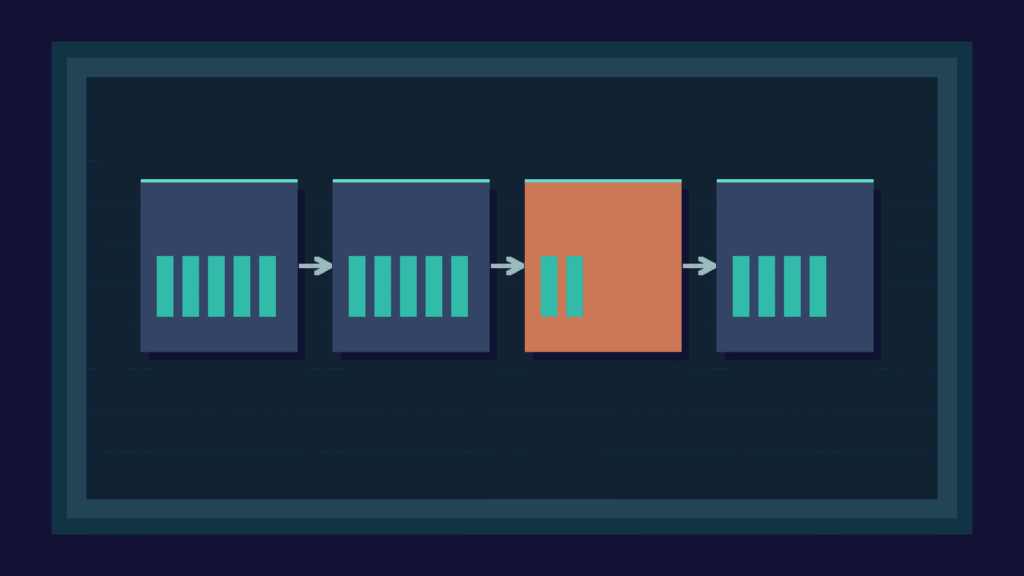
The Theory of Constraints, or TOC, is an improvement approach that concentrates attention on the condition limiting a system’s ability to achieve its objective. Improving every activity independently may consume substantial resources without producing a better overall result. A constraint-focused investigation asks what currently limits the relevant outcome, how existing resources can be used more effectively and what changes would improve the complete system. The original fictional examples below show how to apply the five focusing steps to ordinary preparation and service workflows, calculate capacity and identify when a previously useful improvement no longer addresses the limiting condition.
Quick Answer
Identify the limiting condition, make appropriate use of it, align supporting activities, elevate its capacity when justified and repeat the investigation when the system changes.
Table Of Contents
- What Is Theory Of Constraints?
- Worked Example: Establish A System Objective And Capacity
- Step One: Identify The Constraint
- Step Two: Exploit The Constraint
- Step Three: Subordinate Other Activities
- Step Four: Elevate The Constraint
- Step Five: Repeat And Avoid Inertia
- Worked Example: A Shared Resource With Different Work Types
- Reusable Theory Of Constraints Worksheet
- Frequently Asked Questions
What Is Theory Of Constraints?
The Theory of Constraints Institute overview explains the emphasis on identifying the system constraint and improving overall throughput rather than optimizing isolated functions. The Lean Enterprise Institute definition also describes TOC in terms of managing constraints and improving throughput. The approach originated with Eliyahu Goldratt and has applications beyond production, including project and service management.
The five focusing steps provide a process for ongoing improvement. Identify the constraint, exploit it, subordinate other activities to the resulting decision, elevate the constraint if needed and repeat the investigation after the constraint changes. The Theory of Constraints Institute guide to the five focusing steps describes these stages and the importance of avoiding inertia after improvements.
In this article, throughput means the number of accepted comparable units completed per defined time period. Financial throughput accounting uses specific monetary concepts that are not the subject of these examples. State the meaning of throughput before making comparisons so that a count of unfinished work is not confused with accepted output or financial performance.
Worked Example: Establish A System Objective And Capacity
Consider a fictional reusable exhibition stand supplier that prepares standard nonhazardous display accessory packs for authorized collection. The system begins with an eligible order and ends with an accepted pack ready for handover. It has four sequential stages: order preparation, component gathering, final verification and handover preparation. Assume the modeled units are comparable, every stage has appropriate available resources and there are no losses or repeated routes in the initial simplified model.
| Stage | Usable Capacity Per Operating Day |
|---|---|
| Order Preparation | 28 Packs |
| Component Gathering | 24 Packs |
| Final Verification | 16 Packs |
| Handover Preparation | 22 Packs |
If demand is sufficient and the stages operate as modeled, final verification limits the maximum sustainable flow to 16 packs per day. The other capacities exceed that value. Preparing 28 orders per day would not establish a throughput of 28 accepted packs if verification can handle only 16.
Our bottleneck analysis examples discuss how to investigate limiting stages and actual capacity. TOC builds on that investigation by establishing a sequence of system-level improvement decisions. The limiting condition must be identified from evidence rather than selected merely because one stage appears busy.
If the supplier receives only 12 eligible orders per day, the simplified internal capacities may be sufficient to satisfy demand. Under those conditions, demand or another relevant condition could limit actual throughput instead of verification capacity. The system objective and demand boundary matter when interpreting the capacity table.
Step One: Identify The Constraint
The supplier observes that prepared packs accumulate before verification. The review role is frequently occupied, and the handover preparation stage sometimes lacks verified packs. These observations are consistent with the modeled constraint, but the team should investigate whether verification itself is the limiting condition or whether a supporting resource prevents the expected verification capacity from being used.
Examine the actual time required for the relevant work, the available time, the arrival of eligible review-ready items and repeated work. Suppose the review role has 240 usable minutes per operating day and requires an average of 15 minutes to verify a comparable pack under the established arrangement. Dividing 240 by 15 gives a nominal modeled capacity of 16 packs per day.
That arithmetic assumes the full 240 minutes are available for the relevant verification activities and that the average work content is appropriate for the modeled population. If several packs need additional clarification, the actual usable output may be lower. Our data stratification examples explain how differences among work categories can affect aggregate measures.
An apparent constraint can also be a policy or shared dependency rather than a physically limited workstation. For example, a rule requiring all prepared packs to wait until one weekly review window might create a delay even when the reviewer has adequate total capacity over the week. Investigate the actual relationship before deciding which resource or arrangement deserves attention.
Step Two: Exploit The Constraint
Exploiting the constraint means making appropriate use of the existing limiting capacity before committing to additional resources. It does not mean asking someone to work without necessary breaks, bypass required verification or ignore suitable operating conditions. The goal is to reduce avoidable use of the constrained resource and ensure that the work reaching it is genuinely ready.
Suppose the supplier discovers that the reviewer spends an average of three of the 15 minutes locating an approved reference that could be made reliably available through a suitable preparation arrangement. If that avoidable retrieval can be reduced to one minute while preserving the required verification, the modeled average review work becomes 13 minutes per pack.
With 240 usable minutes, the modeled rate becomes approximately 18.46 packs per day. For a simple daily plan requiring complete accepted packs, 18 whole packs might be a more practical illustrative capacity, assuming work cannot be carried into another period. The actual sustainable rate depends on variability, operating conditions and the handling of partly completed work.
| Review Arrangement | Mean Minutes Per Pack | Modeled Rate Per Day |
|---|---|---|
| Original | 15 | 16 |
| Reduced Avoidable Retrieval | 13 | 18.46 |
Our 5S examples describe organizing necessary references and resources for reliable use. Our spaghetti diagram examples examine unnecessary movement. Both methods may help exploit a verified constraint when they address its actual work mechanism. A reduction in retrieval time outside the limiting stage might still be useful, but its effect on overall throughput requires separate examination.
Step Three: Subordinate Other Activities
Subordination means aligning other activities with the decision about the system constraint. If upstream stages produce work much faster than the verification stage can accept it, the resulting queue consumes resources and may create additional coordination. The objective is to support the flow of appropriate work through the limiting condition, not to maximize activity counts at every stage.
Return to the initial capacity of 16 verified packs per day. If preparation releases 24 comparable packs each day and 16 reach accepted completion, the modeled unfinished inventory increases by eight per day, assuming no other boundary movements. Over five days it increases by 40 packs. An increase in starts has not created an equal increase in accepted output.
| Daily Release | Daily Accepted Output | Net Daily Inventory Change |
|---|---|---|
| 24 | 16 | +8 |
| 16 | 16 | 0 |
| 14 | 16 | −2 While Suitable Existing Inventory Is Available |
The final row depends on sufficient existing eligible inventory. If only 14 items arrive each day and there is no backlog, the system cannot sustain 16 completions indefinitely. A release policy must account for actual demand, the existing stock and the relevant variability.
Our Kanban board examples explain the use of explicit work-in-progress controls. A constraint-focused release arrangement can help avoid unnecessary accumulation while keeping appropriate work available to the limiting resource. Test the actual policy rather than assume that a rigid release number will work under every demand pattern.
Subordination may involve moving legitimate preparation tasks away from the limiting role, coordinating the arrival of review-ready work or protecting its required information availability. Verify that the receiving role has appropriate capability and resources. Moving work to another stage without considering its capacity can create a different bottleneck or degrade the accepted outcome.
Step Four: Elevate The Constraint
If the system remains limited after reasonable use of existing capacity and alignment of other work, examine ways to increase the relevant capacity or change the limiting arrangement. Elevation may involve suitable additional resources, a revised authorized work arrangement or another change that expands usable capacity. Evaluate its consequences and feasibility.
Suppose the supplier establishes an appropriately authorized additional review arrangement, raising verified review capacity to 26 comparable packs per day. The other modeled capacities remain 28, 24 and 22. Under the same sequential flow assumptions, the overall modeled capacity is now 22 packs per day, because handover preparation is the smallest remaining capacity.
| Stage | Initial Capacity | After Elevation |
|---|---|---|
| Order Preparation | 28 | 28 |
| Component Gathering | 24 | 24 |
| Final Verification | 16 | 26 |
| Handover Preparation | 22 | 22 |
| Modeled System Capacity | 16 | 22 |
The system capacity increases by six packs per day, or 37.5% relative to the original 16. The ten-pack increase in verification capacity does not create a ten-pack increase in system output because another stage becomes limiting. This is a capacity calculation, not evidence of actual accepted throughput; demand and actual operating performance still matter.
Our resource allocation examples explain how additional resources need to be verified against the actual timing and capability requirements. A commitment to more review capacity should not be based on a nominal schedule that cannot be fulfilled.
Step Five: Repeat And Avoid Inertia
After the verification capacity increases, the original decision rules may no longer be appropriate. A release policy designed around 16 packs per day may unnecessarily restrict a system that can now sustainably complete 22 under the modeled conditions. Review the new limiting condition and determine whether the original supporting arrangement still serves the objective.
The five focusing steps are therefore an ongoing process rather than a one-time project. The supplier may next examine handover preparation, but it should not assume that the lowest estimated capacity is necessarily the actual constraint after the change. Verify actual flow, demand and readiness at the newly relevant stage.
Our behavior over time graph examples show how changes in outstanding work and throughput can be examined across periods. Preserve the baseline and the conditions under which the improvement was introduced. A temporary change in demand could affect the observed throughput even when the new capacity is genuinely available.
Worked Example: A Shared Resource With Different Work Types
A fictional community language materials exchange prepares standard and customized reference packs. One authorized review role has 180 usable minutes per day. A standard pack requires ten review minutes, while a customized pack requires 30. The resource can theoretically verify 18 standard packs or six customized packs if it performs only one type.
Suppose the actual eligible demand mix is nine standard packs and three customized packs per day. The required review effort is nine times ten plus three times 30, giving 180 minutes. The complete 12-pack daily mix uses all modeled review capacity. If the mix changes to six standard and six customized packs, the required effort becomes 60 plus 180, or 240 minutes. The same count of 12 packs now exceeds the review capacity by 60 minutes.
| Demand Mix | Standard Review Time | Customized Review Time | Total |
|---|---|---|---|
| 9 Standard, 3 Customized | 90 Minutes | 90 Minutes | 180 Minutes |
| 6 Standard, 6 Customized | 60 Minutes | 180 Minutes | 240 Minutes |
The team should not simply prioritize only standard packs to maximize the number of completed units. The objective includes legitimate service commitments and the relevant request population. Investigate appropriate scheduling, work preparation, resource availability and any authorized priority rules. Our trade-off analysis examples explain why an isolated output count may not capture all relevant consequences.
A shared-resource constraint can affect several work routes that look independent on a process map. Our dependency mapping examples show how to represent these common conditions. The improvement investigation needs to reflect the actual demand mix and supporting resources rather than use a single average rate regardless of work composition.
The time available to a constrained resource can be lost through missing prerequisites even when its scheduled capacity appears sufficient. For example, the exhibition stand supplier might find that several packs arrive without the approved reference needed for review. If the reviewer spends a significant part of the available window investigating those gaps, the effective verification capacity may be less than the original estimate. A revised upstream readiness definition could help the team identify which packs genuinely qualify for review. That change should not simply move unresolved work out of the visible queue. Record unresolved items and their age, and verify that the complete service outcome improves.
The improvement team should also distinguish increased capacity from decreased flow time. A larger verification capacity might permit additional throughput, but the actual residence time depends on work in process and the operating arrangement. Our Little’s Law examples explain the relationship among compatible average inventory, throughput and residence time. Use those measures to examine whether the improvement supports the actual delivery objective rather than relying on the increase in one stage’s capacity.
When several candidate constraints appear equally significant, examine their interaction and the decision horizon. A resource might limit one demand mix during the morning while another limits a different mix later in the week. The team may need a more detailed observation or scheduling model. Do not declare one permanent constraint based solely on an average capacity table. Focus the improvement on the limiting condition supported by the evidence under the relevant scope, and reassess when that scope or the operating conditions change.
Reusable Theory Of Constraints Worksheet
| Field | What To Record |
|---|---|
| Objective | Defined System Outcome And Boundary |
| Constraint | Evidence Of Current Limiting Condition |
| Exploit | Appropriate Use Of Existing Limiting Capacity |
| Subordinate | Supporting Activities And Release Decisions |
| Elevate | Feasible Additional Capacity Or Changed Arrangement |
| Verify | Accepted Throughput, Workload And Other Outcomes |
| Repeat | New Limiting Condition And Revised Policies |
A useful TOC investigation connects its improvement decisions to the actual system objective. Examine the evidence for the constraint, preserve the required acceptance conditions and verify whether the proposed change improves the complete flow. Reassess the system after the constraint changes instead of continuing to optimize a formerly limiting stage by habit.
Frequently Asked Questions
What is Theory of Constraints?
An improvement approach focused on the condition limiting a system’s achievement of its objective.
What are the five focusing steps?
Identify, exploit, subordinate, elevate and repeat after the constraint changes.
What is a constraint?
A condition limiting the relevant system outcome under the defined circumstances.
Does every busy stage represent a constraint?
Actual flow, demand and dependencies must be examined.
What does exploit mean?
Make appropriate use of existing limiting capacity while preserving requirements.
What does subordinate mean?
Align supporting work with the constraint-focused improvement decision.
What does elevate mean?
Increase or change the limiting capacity through a suitable feasible arrangement.
Can a policy be a constraint?
Yes, an operating rule or shared dependency may limit the relevant outcome.
Does extra constraint capacity guarantee the same throughput increase?
Another condition may become limiting, and demand or other assumptions may differ.
Why repeat the focusing steps?
The limiting condition and useful operating policies can change after improvement.