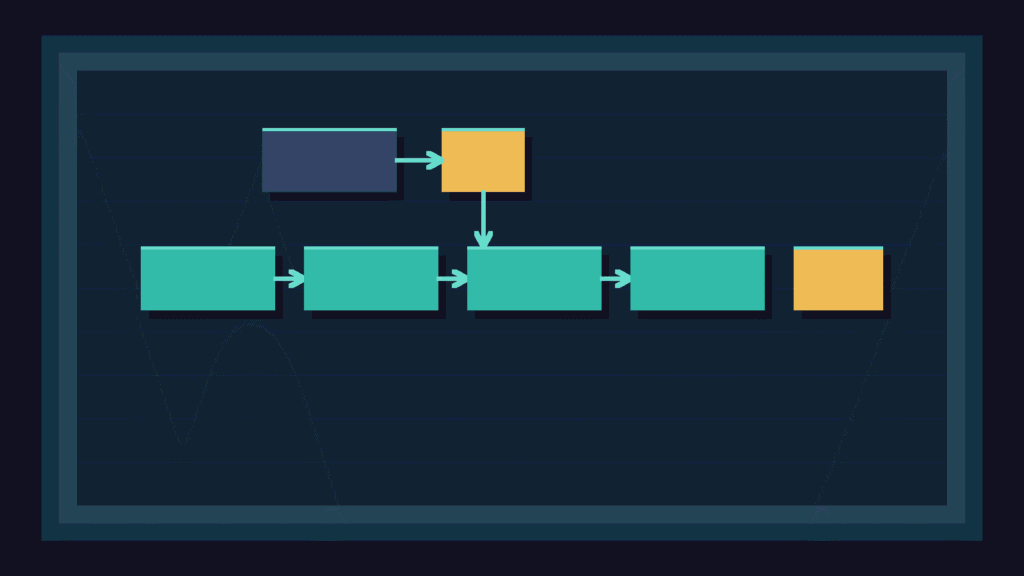
Critical chain project management, or CCPM, is a scheduling and execution approach that explicitly considers limited resources and the protection of project delivery against uncertainty. A conventional dependency-based schedule can contain simultaneous activities that cannot actually use the same specialist. Critical chain scheduling addresses such resource relationships and uses buffers to manage uncertainty in the resulting plan. The original fictional examples below distinguish the critical chain from a dependency-only critical path, calculate illustrative buffers and interpret changes in the remaining completion allowance.
Quick Answer
Build a resource-feasible schedule, identify the chain controlling completion, establish justified project and feeding buffers, and review actual progress and remaining buffer against the commitment.
Table Of Contents
- What Critical Chain Scheduling Adds
- Worked Example: Build The Dependency-Only Schedule
- Calculate A Resource-Feasible Critical Chain
- Understand The Project Buffer
- Worked Example: Establish A Feeding Buffer
- Compare A Resource Buffer With A Time Buffer
- Worked Example: Calculate Buffer Consumption
- Examine Buffer Sizing Assumptions
- Manage Execution Without Hiding Problems
- Reusable Critical Chain Planning Worksheet
- Frequently Asked Questions
What Critical Chain Scheduling Adds
The Project Management Institute article on the merits and pitfalls of critical chain scheduling explains the practice of aggregating some schedule protection into a project buffer rather than attaching all protection to individual activity dates. The method also considers the resources required to execute the activities and the effect of competing assignments.
A critical path is a sequence of logically dependent activities that controls completion under the relevant schedule assumptions. A critical chain also takes into account resource dependencies arising from the actual feasible arrangement. When a single person must perform two otherwise independent tasks, the requirement to sequence those tasks may extend the chain controlling completion.
Our resource leveling examples demonstrate how limited resources can alter a feasible schedule. Critical chain planning uses a resource-feasible arrangement as a foundation and addresses the uncertainty associated with achieving the planned completion.
Do not interpret the method as permission to impose arbitrarily short task durations or unrealistic work conditions. Estimates need an appropriate meaning and credible basis. The buffer is not a substitute for necessary resources, legitimate work requirements or a complete schedule network.
Worked Example: Build The Dependency-Only Schedule
A fictional independent historical photograph archive is preparing an approved exhibit guide. Its work consists of confirming the guide structure, preparing two sets of catalog information, preparing a separate reference index and completing the final coordinated review. The simplified activity durations use operating days.
| Activity | Duration | Predecessor | Required Role |
|---|---|---|---|
| A: Confirm Guide Structure | 2 Days | None | Coordinator |
| B: Prepare Photograph Captions | 4 Days | A | Catalog Specialist |
| C: Prepare Collection Notes | 3 Days | A | Catalog Specialist |
| E: Prepare Reference Index | 2 Days | None | Index Contributor |
| D: Final Coordinated Review | 2 Days | B, C And E | Reviewer |
Ignoring the specialist’s resource limit, the dependency-only schedule would perform A during days one and two, B during days three through six and C during days three through five. E could occur during days one and two. D would take place during days seven and eight. The resulting finish would be day eight.
The longest logical path is A, B, D, lasting eight days. A, C, D lasts seven days, while E followed by D lasts four. The network assumes both B and C can occur concurrently, but their stated resource requirement indicates that a single catalog specialist must perform both.
Our Gantt chart examples show how dependencies and overlapping work can be represented. Here the dependency-only chart is incomplete as a statement of actual feasibility because it does not resolve the specialist’s competing assignments.
Calculate A Resource-Feasible Critical Chain
The archive has only one suitably available catalog specialist. Assume B and C each require the full specialist capacity throughout their duration, cannot overlap and must preserve their stated work content. One feasible arrangement is B during days three through six and C during days seven through nine. The final review then occupies days ten and eleven.
| Activity | Resource-Feasible Timing |
|---|---|
| A | Days 1–2 |
| B | Days 3–6 |
| C | Days 7–9 |
| E | Days 1–2 |
| D | Days 10–11 |
| Unbuffered Finish | Day 11 |
The schedule-driving chain includes A, B, C and D. The B-to-C relationship arises from the selected resource sequence rather than an original technical requirement that captions must precede collection notes. Under the simplified assumptions, performing C before B would still require seven catalog specialist-days after A and produce the same eleven-day finish.
If a new resource becomes available or the work content changes, the relevant resource-feasible chain may change. Review the actual dependencies and schedule rather than continue managing the original chain without reconsideration.
Our dependency mapping examples explain why different kinds of prerequisites should remain visible. Label logical and resource-created sequence relationships clearly so that an appropriate later change can be evaluated.
Understand The Project Buffer
A project buffer protects the intended delivery commitment against uncertainty in the chain controlling completion. In the archive example, the unbuffered modeled finish is day eleven. Suppose the team establishes an illustrative three-day project buffer, producing a day-fourteen planned delivery commitment under the simplified calendar.
The three-day buffer is a teaching assumption, not an empirically justified confidence allowance. A real buffer-sizing method needs to consider the definitions of the task estimates, the evidence about variation, correlations, other paths and the organization’s actual delivery-risk objective. Different sizing methods may produce materially different results.
The PMI discussion of critical chain buffer management provides further context on treating buffers as a means of managing schedule uncertainty. A buffer should remain connected to the risk it is intended to protect, rather than become an unexplained quantity added to the end of the plan.
| Schedule Quantity | Illustrative Value |
|---|---|
| Unbuffered Critical Chain Finish | Day 11 |
| Project Buffer | 3 Days |
| Protected Delivery Boundary | Day 14 |
Distinguish the planned unbuffered finish from the promised boundary. If the archive completes on day twelve, it uses one day of the project buffer while still meeting the modeled day-fourteen commitment. The meaning of that observation depends on the actual measurement convention used to track completion and buffer consumption.
Worked Example: Establish A Feeding Buffer
The reference index activity E does not initially control completion, but it is a prerequisite for D. In the resource-feasible plan, D can begin after the catalog specialist’s two preparations finish at the end of day nine. E must be ready by that merge point.
Suppose the archive chooses to schedule E during days seven and eight, retaining day nine as a one-day illustrative feeding buffer before D. This timing assumes the index contributor is suitably available and E has no other unresolved prerequisite.
| Feeding Element | Timing |
|---|---|
| E: Reference Index Preparation | Days 7–8 |
| Feeding Buffer | Day 9 |
| D: Final Review Begins | Day 10 |
If E takes three days rather than two, it occupies days seven through nine and consumes the one-day feeding buffer without delaying D in this simplified case. If it takes four days, it would finish at the end of day ten and delay D by one day unless another appropriate arrangement is established.
The project buffer and feeding buffer protect different boundaries. The feeding buffer protects the merge with the chain, while the project buffer protects final delivery. Do not automatically add every feeding buffer to the total project duration; consider the actual placement and relationships in the network.
Our milestone planning examples explain the importance of establishing all necessary readiness conditions before a coordinated activity begins. A buffer is useful only if the relevant predecessor actually becomes ready by the merge boundary.
Compare A Resource Buffer With A Time Buffer
Some critical chain approaches distinguish a resource buffer from the project and feeding time buffers. A resource buffer can function as a readiness signal or coordination arrangement ensuring that a necessary resource is prepared when the work becomes eligible. It need not represent an additional period added to every task.
For the archive, the final reviewer may need notice that D is approaching so the appropriate review window can be established. The coordinator could use a defined notification trigger connected to the remaining catalog work and current forecast. That notification does not establish the reviewer’s actual availability; the availability still needs to be confirmed.
The PMI resource buffer management discussion describes approaches to coordinating the readiness of resources in critical chain scheduling. The applicable method should reflect the real operating arrangements rather than label every notice as a separate duration allowance.
Our communication plan examples distinguish issuing information from establishing the response or decision it supports. A resource readiness signal should identify the intended condition, responsible role and appropriate follow-up.
Worked Example: Calculate Buffer Consumption
Return to the archive’s unbuffered day-eleven finish and three-day project buffer. Assume the team tracks the current forecast finish using the same operating-day convention. At one checkpoint, the forecast is day twelve. The forecast has moved one day beyond the original unbuffered finish, leaving two days before the day-fourteen delivery boundary.
| Forecast Finish | Buffer Used | Buffer Remaining | Commitment Status |
|---|---|---|---|
| Day 11 | 0 Days | 3 Days | Forecast Within Boundary |
| Day 12 | 1 Day | 2 Days | Forecast Within Boundary |
| Day 13 | 2 Days | 1 Day | Forecast Within Boundary |
| Day 14 | 3 Days | 0 Days | Forecast At Boundary |
| Day 15 | 4 Days | −1 Day | Forecast Beyond Boundary |
In this teaching convention, forecast buffer consumption at day twelve is one divided by three, or approximately 33.3%. At day thirteen it is two-thirds, or approximately 66.7%. A forecast of day fifteen represents consumption exceeding the original allowance, rather than a literal negative reserve of time that can be spent.
A useful buffer review also considers how much relevant work remains. Consuming two days of a three-day buffer early in the critical chain may warrant a different investigation from consuming the same amount immediately before a nearly completed final review. Avoid using fixed percentage bands as universal action thresholds without establishing their suitability for the project.
Our schedule risk analysis examples distinguish a deterministic forecast from a modeled probability of completion. A remaining buffer of one day does not establish the probability of meeting the commitment. That depends on the uncertainty and actual remaining work.
Examine Buffer Sizing Assumptions
Suppose a team has prepared a chain with four relatively challenging activities. It has estimated a higher-protection duration and a shorter planning duration for each under a consistent convention. The differences are one, two, one and two days. Their sum is six days.
A simple illustrative pooling convention might allocate half of that aggregate difference to a project buffer, giving three days. Such a heuristic is not a universal risk calculation. It does not, by itself, establish the confidence level of the protected finish. If uncertainties are strongly dependent, or if a consequential discrete event is absent from the estimates, a different allowance may be needed.
Our PERT estimation examples explain how three-point estimates and variance approximations depend on the input definitions. The Monte Carlo simulation examples demonstrate how a complete network can be recalculated across plausible uncertainty states. Those techniques can provide complementary evidence when evaluating the protection associated with a chosen buffer.
Do not simply remove a fixed percentage from every existing activity duration. If those durations represent necessary deterministic work rather than conservative estimates, the resulting tasks may become infeasible. A credible critical chain plan starts with understandable duration estimates and appropriate operating conditions.
Manage Execution Without Hiding Problems
Suppose the catalog specialist reports that the remaining collection notes require one extra day because the applicable approved reference is incomplete. The relevant response is to investigate and resolve that condition, update the forecast and assess its effect on the buffer. Merely asking the contributor to preserve the original activity date does not establish the required reference.
Where a completed task finishes earlier than expected, its successor may be able to begin sooner if the actual prerequisites and suitable resources are ready. An early completion should not automatically be consumed by unrelated work simply because the original task date has not arrived. The appropriate arrangement depends on the overall schedule, commitments and resource constraints.
Our earned value management examples distinguish progress evidence from planned timing and actual cost. Buffer monitoring can complement such reporting, but a favorable buffer position cannot establish that every deliverable meets its requirements. Preserve accepted quality and actual accomplishment evidence.
A useful buffer-monitoring review compares two successive forecasts rather than interpreting buffer use as permanently lost time. Suppose the archive first forecasts day thirteen because the approved reference is delayed. Later, the reference arrives sooner than expected and the remaining work forecast returns to day twelve. Under the stated forecast-based convention, consumption falls from two days to one. Record the reason for that change and verify the actual prerequisites. The improvement is not established by simply changing the reported duration; it must follow from an updated credible remaining-work estimate. Some organizations use other buffer monitoring conventions, so state the one being applied.
When several projects share the same specialist, review the sequence at portfolio level. An early finish on the archive’s catalog work might release the specialist to another project, but beginning that other project before the archive’s remaining specialist work becomes eligible could create a new conflict. A local buffer position is not sufficient to certify that both delivery commitments can be met. Establish the actual resource calendar and the priority of the competing commitments, then update both forecasts where necessary.
Reusable Critical Chain Planning Worksheet
| Field | Record |
|---|---|
| Network | Activities, Durations And Logical Dependencies |
| Resources | Suitable Roles, Capacity And Calendars |
| Feasible Chain | Resource-Constrained Sequence |
| Feeding Paths | Merge Points And Supporting Work |
| Buffer Basis | Estimation Convention, Uncertainty And Sizing Method |
| Project Buffer | Unbuffered Finish And Protected Commitment |
| Readiness | Resource Signals And Confirmed Availability |
| Monitoring | Actual Progress, Forecast And Buffer Use |
| Response | Investigation, Authorized Changes And Verification |
A final review should test the assumptions against plausible changes. If the archive’s reference index later requires the catalog specialist rather than an independent contributor, the resource-feasible plan must be recalculated. The original feeding buffer may no longer describe the relevant relationship. If the final reviewer is available only on certain dates, missing one review window can have a different effect from a simple one-day duration extension.
Critical chain project management is most useful when the chain, buffers and execution decisions reflect the actual work and uncertainty. Use buffers to make the protection of the delivery commitment visible, not to obscure missing resources or unrealistic estimates. Keep the planned and actual conditions understandable so the team can respond to evidence rather than merely report that a buffer has been consumed.
Frequently Asked Questions
What is critical chain project management?
A resource-aware approach to project scheduling and execution that uses buffers to manage uncertainty.
How does a critical chain differ from a critical path?
The critical chain accounts for resource-driven relationships as well as logical dependencies.
What is a project buffer?
A time allowance intended to protect the final delivery commitment.
What is a feeding buffer?
A time allowance intended to protect a merge where a supporting path feeds the chain.
What is a resource buffer?
A readiness or coordination mechanism intended to make necessary resources available when needed.
How is buffer consumption calculated?
Use a defined monitoring convention relating forecast changes to the established allowance.
Is one buffer size appropriate for every project?
No; sizing depends on estimates, uncertainty and actual delivery objectives.
Does a positive remaining buffer guarantee delivery?
It shows remaining modeled allowance, not a guaranteed completion probability.
Can a resource change alter the critical chain?
Yes, recalculate the feasible schedule when important resource conditions change.
What should a buffer review establish?
Remaining work, actual forecast, relevant uncertainty, readiness and appropriate response.